At a Glance

Flipping your classroom can improve students’ learning. But is it right for your course?

This guide will help you decide whether to flip your class. It will also introduce you to the design work that’s involved in flipping a class: choosing pre-class work, planning in-class time, and encouraging students to arrive prepared.

Tip: Interested in flipping a class session, a module, or an entire course? Connect with us. You can partner with the Teaching and Learning Technologies team at any stage in the process.

1. What is a flipped classroom?

When you flip your class, you move foundational material to pre-class time and use the class time that opens up for active, applied work: case discussion, problem-solving, working through an analysis together. Flipping the classroom has been shown to improve student performance compared with traditional lecturing (Strelan et al., 2020).

Those gains may come less from the flip itself than from active learning that fills the freed-up class time. A large body of research finds that students in active learning classrooms outperform those in lecture-based ones (Center for Teaching Innovation, n.d.; Freeman et al., 2014; Kozanitis & Nenciovici, 2023). Flipping helps make room for active learning.

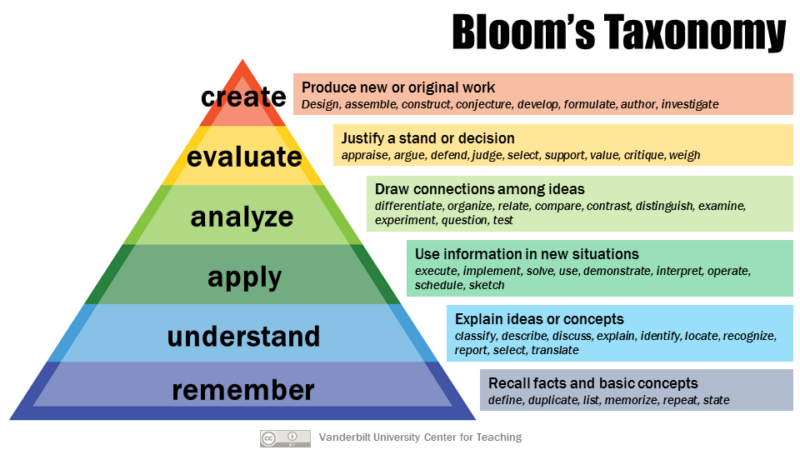
Bloom's Taxonomy shown as a pyramid of six levels, from remember at the base through understand, apply, analyze, and evaluate, to create at the top.

Bloom’s Taxonomy by the Vanderbilt University Center for Teaching, CC BY 2.0

Bloom’s Taxonomy—a framework for thinking about different kinds of cognitive gain—can help you think about what tasks work best as pre-class versus in-class work (Derek Bok Center for Teaching and Learning, n.d.). The lower levels of the taxonomy are about students’ ability to remember and understand information. The middle levels focus on how students apply and analyze information. The top of Bloom’s taxonomy focuses on how students use information to evaluate options and create new ideas or products.

Foundational material that lives at the “remembering” and “understanding” levels of Bloom’s taxonomy is a good candidate for outside-of-class work. Higher-order work like applying, analyzing, evaluating, and creating can benefit from your guidance, peer interaction, and the chance to work through difficulty together. Those are ideal for class time.

A quick example: In a core operations course, the definitions and arithmetic behind inventory formulas sit at the remember-and-understand levels and travel well to a pre-class video. Deciding which policy a company should actually adopt—and defending it against a classmate who chose differently—is evaluation work that benefits from class time.

2. Is a flipped classroom right for what I teach?

To decide if this approach makes sense for your course, think about whether there are specific sessions or modules where content delivery is taking up time that you’d rather use for application. Maybe you’re wondering if the time you spend introducing negotiation frameworks could be better used for practice. Or you spend half a session walking students through DCF mechanics before you can get to a valuation case.

In each case, students need the foundational content but don’t necessarily need you delivering it in the room. Moving that content to pre-class frees up the class session for higher-order work.

When a flipped classroom may not be the right fit:

  • The content introduction requires real-time instructor mediation. Pre-class work assumes students can engage with material productively on their own. If your content requires substantial scaffolding, generates lots of student questions, or produces misconceptions that need immediate correction, it might not be a good candidate for a flipped approach.
  • Your students already arrive with the foundational content. In advanced electives or cohorts with strong prior coursework, pre-class material could seem redundant. In these cases the question is usually how wide the range in the room actually is. A short Qualtrics survey or Poll Everywhere poll can tell you whether pre-work would be useful or redundant.
  • Your class is already mostly active learning. If you’re already running cases, simulations, or workshops with relatively little lecture, your students are already experiencing many of the benefits of a flipped model. Changing the order of instruction might not have additional learning benefits (Jensen et al., 2015).

Tip: If you’re uncertain whether your content fits a flipped model, that’s a useful early question for a consultation with an instructional designer. We can help you think through which sessions or modules are good candidates for a flipped classroom.

3. Does the pre-work have to be video?

Most faculty picture recorded lectures when they hear “flipped classroom.” However, a flipped class doesn’t actually have to include any videos. Students could instead read an article, read a case, or listen to a podcast before class. Ideally, they’ll follow that up with a low-stakes task that helps them reflect on and consolidate what they’ve learned.

Pre-Class Content

Anything students can learn from on their own can be a good use of pre-class time. The real choice is which kind of content makes the most sense for what you’re teaching. Here are a few different types of pre-class work you could assign:

Content When It Works Well
Short instructional video Procedural demonstrations and software walkthroughs, or content where students benefit from watching you model a thought process
Podcast Hearing expert interviews or first-person perspectives on a topic
Reading (article, chapter, case) Conceptual material, background context, or content students annotate and re-read at their own pace

Tip: If you want to create a video for students to watch before class, contact our Teaching Studio team to learn about recording videos on campus in the MIT Sloan Teaching Studio.

It’s important to make your pre-work accessible so all your students can complete it. That means including captions for video (videos produced in the Teaching Studio are captioned as part of production), providing transcripts for podcasts and other audio, and sharing readings as accessible documents using Study.Net.

Pre-Class Task

Watching or reading, on its own, is weak preparation. Students learn by retrieving and reflecting on the material, not just encountering it (Adesope et al., 2017; Roediger & Karpicke, 2006). That’s why the content is only half the assignment. The other half is a small task that asks students to do something with what they’ve watched or read. Here are a few examples of pre-work tasks you could assign:

Task Benefit
Answer two or three guided questions Helps students know what to look for in the reading or video
Take a low-stakes Canvas quiz Surfaces what students don’t yet understand before class, and the retrieval itself produces durable learning
Complete a short guided exercise or problem set Provides practice before students apply new concepts in class; include a worked example if a procedure is new
Have a conversation with an AI tool, with something to bring back Enables exploratory engagement or brainstorming; the artifact students bring (the transcript, or three generated examples with a short critique) is what makes the work visible

One thing to consider: Students can use an AI tool to do any homework you assign. That’s not a reason to skip assigning the task, but it is a reason to grade it lightly. The class session that follows can also impact students’ approach to pre-work. When what you do in class clearly builds on what they read or watched beforehand, students who did the work themselves are most prepared to take part.

4. How can I redesign my in-class time?

Your pre-class work introduced students to new concepts, frameworks, or analysis techniques. That means students have encountered the material once—but they might not know what to do with it. Now your class time can move students through these three steps (Renkl & Atkinson, 2003).

Step Purpose Negotiations Class Example
1. Worked example Students see the technique applied start to finish. A worked example is a fully solved problem, walked through step by step, with the reasoning behind each step made explicit—not just what you did, but why you did it. You and a TA demo a short negotiation, stopping to name each move as it happens.
2. Practice version Students work a partially completed version—you supply some steps, they fill in the rest. Leaving out a step or two, rather than handing over a blank problem of the same type, is what makes this step more than a repeat of the example. Students run a structured negotiation role play with a coaching sheet listing the moves.
3. Independent attempt Students apply the technique to a new problem on their own, without a model in front of them. Students take part in a multi-party negotiation that you then debrief together.

The idea is that each step removes a little of the scaffolding that the step before it provided. Students watch expert reasoning, then reproduce it with help, then generate it themselves. The failure mode to avoid: jumping straight from a short introduction to a case or discussion that depends on fluent application.

Tip: This sequence assumes students are new to this specific technique. Learners who already know a procedure may learn more from simply solving the problem than from going through a worked example. In a cohort with mixed backgrounds, a brief pre-class Canvas quiz can help you learn which students would benefit from skipping ahead to the independent problem.

Research also links certain facilitation moves to more positive student responses—and, for the wrap-up, to better learning:

  • Give each activity a clear introduction. Before students start, explain what they’re expected to do, what the activity is for, and how it connects to their learning and to graded work. In a study of 1,020 students across 21 institutions, students who reported that their instructor introduced activities using those specific strategies valued the activities more, felt more positive, participated more, were less distracted, and planned to rate the course higher at the end of the term (Andrews et al., 2022).
  • Be an active facilitator. Walk around the room to help students as needed, approach students who aren’t participating, invite questions during the activity, and ask students for feedback about how the activity went. The same study found these facilitation strategies were also associated with positive student responses, including higher planned course evaluations, though clear explanation showed the stronger relationship (Andrews et al., 2022).
  • End every activity with a wrap-up. After students work a problem, don’t just show the right answer and move on. Walk through the solutions students produced, name the most common mistakes, and restate what the activity was meant to teach (Andrews et al., 2022; Wisniewski et al., 2020). In the negotiation example above, the group debrief isn’t a nice-to-have at the end; it’s where the session’s learning consolidates.

Additional Resources

5. What if students don’t do the pre-work?

This is a common concern faculty raise about flipping. An active in-class session assumes students arrive prepared. If they don’t, you’re either re-teaching content during class or running activities students struggle to follow. The good news is that you can make design choices that increase completion rates. The strategies below come from research and faculty practice, and they reinforce each other.

When planning and introducing the pre-class assignment:

  • Tell your students that the pre-class work will be checked or assessed, that in-class activities will assume prior knowledge, and that you won’t re-deliver pre-class content during class.
  • Follow through by making the in-class activity genuinely depend on the pre-class work. When a case discussion, problem set, or role-play assumes prior knowledge, students who didn’t prepare can’t fully participate. The design itself communicates that prep is part of how the course works, not an optional add-on.
  • Keep it short. It will be easier for students to fit in a 5-minute video, a single reading, or a 4-question quiz than something longer. A concise introduction also leaves more room for the pre-class task that will help students remember the new content.

During class

  • Open with a quick check that builds on the pre-class work. A start-of-class think-pair-share, low-stakes Poll Everywhere poll, or short discussion activates what students already know, shows you where the gaps are, and signals that preparation matters.
  • Don’t re-deliver the pre-class content. A 10-minute mini-lecture recapping the video is a partial reversion to lecture, and it substitutes for the prior knowledge your opening check would have activated. Faculty also report a behavioral pattern: when students who skipped the pre-class work get the content in class anyway, completion drops the next time.

6. How do I get students on board?

If you’re worried students will resist a flipped format centered around in-class active learning, the evidence is reassuring. In a systematic literature review about student response to active learning, one study found that just 57 of the 412 studies reported any type of negative response to active learning from students (Shekhar et al., 2020). In surveys of nearly 1,500 undergraduate students, the same authors found that responses to active learning were mostly positive (Andrews et al., 2020).

The real challenge is subtler: students can learn more from active formats while feeling they learn less. In a randomized experiment at Harvard, students attended physics sessions that were similar in every respect—same handouts, same slides, same example problems—except that one room heard a skilled lecture while the other worked the problems in small groups before seeing the same solution. The active sessions produced higher test scores but a weaker feeling of learning (Deslauriers et al., 2019). The authors’ explanation: a fluent lecture is easy to follow, and students read that ease as learning. Effortful problem-solving is full of dead ends, and students read that effort as a sign the class is failing them, even when the effort is what produces the learning.

Notably, when the researchers interviewed students afterward, no one objected to the group work itself. Students complained that class felt disjointed and that their mistakes might go uncorrected. Much of the answer, then, is likely the design work in Section 4: deliberate introductions, active facilitation, real wrap-ups. What remains is helping students track their own progress:

  • Explain the perception gap on day one. Tell students plainly that how much a class feels like it’s working is a poor guide to how much they’re learning. Show them the study, and repeat the message when the work gets hard (Deslauriers et al., 2019).
  • Give students a real read on where they stand. Your low-stakes quizzes already do this. To sharpen it, ask students to rate their confidence on each question. In a randomized study of 162 students, weekly practice at judging their own answers improved the accuracy of students’ self-assessment—but only when paired with immediate feedback telling them whether they’d been over- or underconfident (Wang et al., 2024).
  • Ask how it’s going, and make sure students see you respond. A one-minute paper or anonymous Poll Everywhere poll can surface doubts in time to address them. You could also use Qualtrics to run a structured mid-semester feedback survey.

Tip: The supplementary materials for Deslauriers et al. (2019) include the slides from the presentation the instructor used to explain the perception gap with active learning, annotated with notes on what each slide covered. They’re a useful starting point for your own day-one framing, and an instructional designer can help you adapt them to your course.

7. How do I get started?

To get started, request a consultation with the Teaching and Learning Technologies team. The first conversation will focus on your content, what your in-class redesign might look like, and how we might partner on the project. The same request reaches the Teaching Studio team if your project involves video production. Instructional design consultations and studio sessions are scheduled based on team availability, so it’s worth starting the conversation early.

References

Adesope, O. O., Trevisan, D. A., & Sundararajan, N. (2017). Rethinking the use of tests: A meta-analysis of practice testing. Review of Educational Research, 87(3), 659–701. https://doi.org/10.3102/0034654316689306

Andrews, M. E., Graham, M., Prince, M., Borrego, M., Finelli, C. J., & Husman, J. (2020). Student resistance to active learning: Do instructors (mostly) get it wrong? Australasian Journal of Engineering Education, 25(2), 142–154. https://doi.org/10.1080/22054952.2020.1861771

Andrews, M., Prince, M., Finelli, C., Graham, M., Borrego, M., & Husman, J. (2022). Explanation and facilitation strategies reduce student resistance to active learning. College Teaching, 70(4), 530–540. https://doi.org/10.1080/87567555.2021.1987183

Center for Teaching Innovation. (n.d.). Active learning. Cornell University. https://teaching.cornell.edu/teaching-resources/active-collaborative-learning/active-learning

Derek Bok Center for Teaching and Learning. (n.d.). Taxonomies of learning. Harvard University. https://bokcenter.harvard.edu/taxonomies-learning

Deslauriers, L., McCarty, L. S., Miller, K., Callaghan, K., & Kestin, G. (2019). Measuring actual learning versus feeling of learning in response to being actively engaged in the classroom. Proceedings of the National Academy of Sciences, 116(39), 19251–19257. https://doi.org/10.1073/pnas.1821936116

Freeman, S., Eddy, S., McDonough, M., Smith, M., Okoroafor, N., Jordt, H., & Wenderoth, M. (2014). Active learning increases student performance in science, engineering, and mathematics. Proceedings of the National Academy of Sciences, 111(23), 8410–8415. https://www.pnas.org/doi/full/10.1073/pnas.1319030111

Jensen, J., Kummer, T., & Godoy, P. (2015). Improvements from a flipped classroom may simply be the fruits of active learning. CBE—Life Sciences Education, 14(1). https://www.lifescied.org/doi/full/10.1187/cbe.14-08-0129

Kozanitis, A., & Nenciovici, L. (2023). Effect of active learning versus traditional lecturing on the learning achievement of college students in humanities and social sciences: A meta-analysis. Higher Education, 86(6), 1377–1394. https://doi.org/10.1007/s10734-022-00977-8

Penny, A. R., & Coe, R. (2004). Effectiveness of consultation on student ratings feedback: A meta-analysis. Review of Educational Research, 74(2), 215–253. https://doi.org/10.3102/00346543074002215

Renkl, A., & Atkinson, R. K. (2003). Structuring the transition from example study to problem solving in cognitive skill acquisition: A cognitive load perspective. Educational Psychologist, 38(1), 15–22. https://doi.org/10.1207/S15326985EP3801_3

Roediger, H. L., & Karpicke, J. D. (2006). The power of testing memory: Basic research and implications for educational practice. Perspectives on Psychological Science, 1(3), 181–210. https://doi.org/10.1111/j.1745-6916.2006.00012.x

Shekhar, P., M. Borrego, M. DeMonbrun, C., Finelli, C. Crockett, and K. Nguyen, 2020. “Negative Student Response to Active Learning in STEM Classrooms: A Systematic Review of Underlying Reasons.” Journal of College Science Teaching 49 (6):45–54.

Strelan, P., Osborn, A., & Palmer, E. (2020). The flipped classroom: A meta-analysis of effects on student performance across disciplines and education levels. Educational Research Review, 30, 100314. https://doi.org/10.1016/j.edurev.2020.100314

Teaching + Learning Lab. (n.d.). Worked examples. Massachusetts Institute of Technology. https://tll.mit.edu/teaching-resources/how-people-learn/worked-examples/

Vanderbilt University Center for Teaching. (2016, September 6). Bloom’s taxonomy [Image]. Flickr. https://www.flickr.com/photos/vandycft/29428436431

Wang, Y., Sperling, R. A., & Malcos, J. L. (2024). Supporting college students’ metacognitive monitoring in a biology course through practice and timely monitoring feedback. Metacognition and Learning, 19(3). https://doi.org/10.1007/s11409-024-09385-y

Wisniewski, B., Zierer, K., & Hattie, J. (2020). The power of feedback revisited: A meta-analysis of educational feedback research. Frontiers in Psychology, 10, 3087. https://doi.org/10.3389/fpsyg.2019.03087